
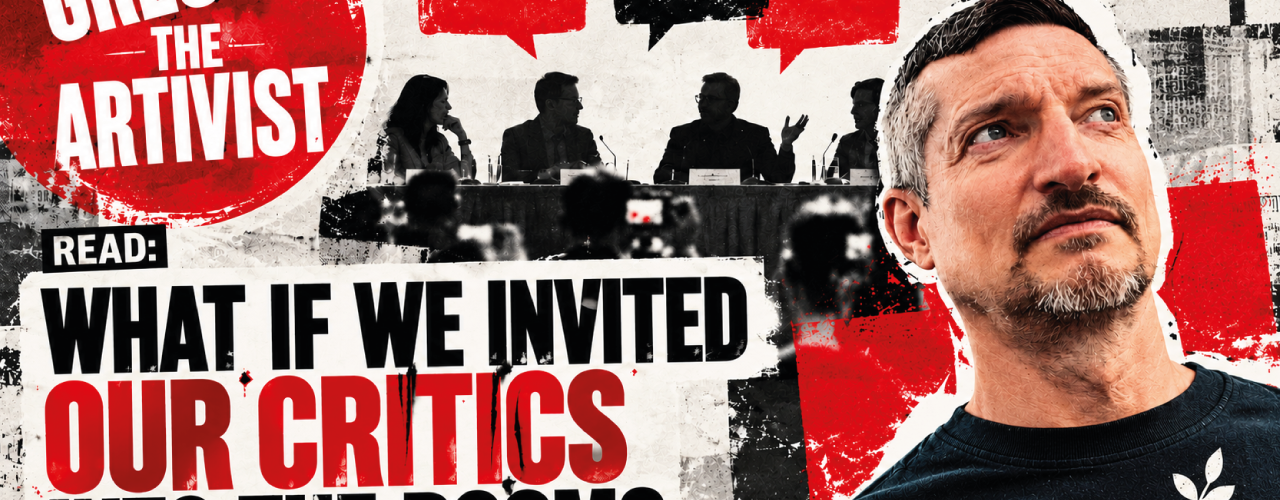


An invitation to rethink how we talk about peace, security and disagreement.
Peace Movement Critics
Following my article last week on the Stop de Oorlogskoorts (Stop the War Fever) national peace protest in Amsterdam on 27 September, I’ve found myself reflecting not only on the criticism directed towards the New Peace Movement, but questioning how we engage with people whose understanding of peace and security is fundamentally different from our own. It’s a question that has challenged me throughout my involvement with the climate movement.
A lot of the public conversation following the demonstration seemed to revolve around competing perceptions. Critics accused the movement of being naïve about aggression and military power, while the movement questioned whether the increasing emphasis on military deterrence and defence spending was bringing us any closer to a more secure world.
But beneath the headlines, the accusations and sometimes dismissive language, particularly towards the peace movement, are questions that deserve far more serious attention.
So I found myself coming back to one thought.
What if we invited the critics into the room?
Beyond defending our positions
With the criticism growing, I was asking my partner the other day to imagine the New Peace Movement doing something quite different from a conventional press conference.
Rather than gathering journalists to explain its positions or respond to criticism, what if it invited some of its strongest critics to participate in a public conversation?
I’m not suggesting a staged confrontation. Nor an opportunity to score political points. And certainly not an exercise in persuading everyone that the peace movement has all the answers. Far from it.
Instead, imagine a carefully moderated discussion where competing ideas about peace, security, deterrence, diplomacy and militarisation could be examined openly, with journalists there to question everyone involved.
It would give the movement an opportunity to explain what it believes, what it proposes and, importantly, what it does not stand for. Those who disagree could articulate their concerns as serious arguments deserving serious responses.
Because surely, if we believe in the importance of peace, we should also believe our ideas can withstand difficult questions.
And the same must apply to those advocating military solutions.
Questions we cannot afford to avoid
Reflecting on the criticism of the past couple of weeks, there are without doubt some difficult questions that really stand out:
- What happens when diplomacy fails or an aggressor refuses meaningful negotiations?
- How do we protect countries and populations facing immediate military threats?
- What responsibility do European countries have towards Ukraine?
- Can military deterrence sometimes prevent war?
- Could policies intended to achieve peace inadvertently transfer the cost of that peace onto people already experiencing aggression?
It would be wrong to simply dismiss these as arguments made by people who favour war.
But neither should military deterrence be treated as an unquestionable answer to insecurity.
The peace movement is already asking its own difficult questions. What constitutes sufficient deterrence? At what point does military expansion contribute to an arms race? What is the long-term objective of increasing military expenditure? Where does diplomacy fit? And how do we know whether our security decisions are actually creating a safer future?
Interestingly, I find these questions belong in the same conversation. They don’t feel mutually exclusive.
What do you think?
I’d genuinely like to hear your perspective.
You can add your thoughts in the comments at the end of this page.
What could this actually look like?
I imagine something relatively simple.
A few representatives from the New Peace Movement. Two or three credible voices who fundamentally disagree with aspects of its position. An independent moderator prepared to challenge everyone equally. And journalists invited not simply to observe, but to ask difficult questions.
The conversation could begin with:
How do we build peace while taking security seriously?
The peace movement explains its thinking. Critics respond. Both are challenged. Questions are explored rather than avoided.
And nobody is required to declare victory. It’s not a debate.
Instead, identify where there is agreement, where fundamental differences remain and which questions still need answering. Record it. Perhaps livestream it. Make the whole conversation available.
Of course it would require preparation. The movement would need to examine its arguments rigorously and be willing to acknowledge uncertainty. Critics would need to participate in good faith. And the moderator would need genuine independence.
I’m not saying this would be easy.
But that’s precisely why I think it is worth considering.
We don’t have all the answers
There is another opportunity here: connecting with the wider public through something we don’t always see enough of in political debate. Genuine openness about what we know, what we don’t know and what we are still trying to understand.
Imagine the peace movement saying:
We don’t have all the answers. We’re not pretending to. We are people who care deeply about the future we are creating, who believe peace deserves far greater attention in our political decisions and who want to explore how we might get there. But we cannot do that alone.
I really feel there is a difference between having strong convictions and claiming absolute certainty.
Peace cannot be left entirely to military strategists, politicians or professional peacebuilders. Their expertise matters enormously, as does the lived experience of people directly affected by conflict. But ordinary citizens also have a legitimate voice in deciding what kind of future they want.
The peace movement does not need to present itself as the authority with every solution. It can also be a place where questions are raised, assumptions challenged and people invited to contribute.
A quieter form of activism?
Now hands up, I recognise that for some within the peace movement this may not feel like particularly strong activism.
Especially for those who have spent years calling for dialogue, only to see conflicts continue and political positions become increasingly entrenched. Even for me, it has taken some reflection. I understand why another conversation might feel insufficient when the urgency of the situation demands action.
But I also think back to my involvement with the climate movement. I saw how difficult it became to bring the wider public into the conversation once people began to feel disconnected from, lectured by, or even hostile towards the movement itself. That is certainly not the whole story of why climate action has stalled, but I think there are lessons worth acknowledging. Years later, even as the impacts of climate change move ever closer to people’s own doorsteps, some of that distance remains.
I don’t want to see the peace movement repeat those mistakes.
Following the recent national peace protest, I listened to a radio panel discussing the New Peace Movement without anyone from the movement participating in the conversation.
Whatever the intentions of the programme, it struck me as a missed opportunity. The public was hearing people discuss a movement’s positions without hearing those positions explained or challenged directly by someone representing it.
What if we could create the conditions for something different?
Bringing peace advocates, critics and journalists into the same room would not guarantee fair coverage or eliminate bias. But it might create the possibility of a more informed public conversation in which people can hear competing arguments and reach their own conclusions.
And I think this is a form of activism in itself.
Not the activism of banners, marches or confrontation, but the quieter work of challenging how public narratives are formed.
A little like what I hope to do with these READ articles.
The method is part of the message
Ok, such an event wouldn’t suddenly resolve disagreements about NATO, Ukraine, Russia, defence spending or European security. Nor should that be its ambition.
It could help the peace movement be understood more accurately, allow critics to explain their objections in greater depth and give journalists something beyond competing soundbites.
And importantly, the movement itself might learn something.
There may be arguments it has underestimated. Questions it has not sufficiently addressed. Assumptions that deserve reconsideration.
That shouldn’t be seen as weakness.
A peace movement isn’t simply advocating for an alternative approach to conflict. It also has an opportunity to demonstrate how disagreement itself can be approached differently.
Not by pretending differences don’t exist. Not by avoiding difficult conversations. And not by assuming that listening means agreeing.
Dialogue alone cannot resolve every conflict. There are circumstances where negotiation is rejected and power is exercised through violence. Acknowledging those realities should be part of the conversation, not a reason to avoid it.
A movement advocating peace could demonstrate that disagreement does not have to become hostility, uncertainty does not have to mean weakness, and listening does not require abandoning our convictions.
An invitation
So this is an idea I’d like to put forward for consideration by the New Peace Movement.
What if, instead of another press statement or another exchange of opposing opinions through the media, we created an opportunity for those opinions to meet?
Invite the critics. Invite the difficult questions. Invite journalists to witness a conversation in which nobody is exempt from scrutiny.
And invite the wider public to see that people calling for peace are not necessarily claiming to know precisely how to achieve it. They are asking that we take the possibility seriously enough to keep exploring it.
I would welcome the opportunity to help develop what such an event might look like, alongside others who believe there is value in trying something different.
Not because peace advocates have all the answers.
But precisely because none of us do.
I'm thinking that perhaps the invitation isn’t simply for our critics to join the conversation. Maybe it’s an invitation for all of us to recognise that the future of peace is too important to leave to any one movement, institution or way of thinking.
Agree, disagree, or somewhere in between? Add your thoughts in the comments at the end of this page.
FAQ's
What is the New Peace Movement?
The New Peace Movement is a Dutch peace initiative bringing together people and organisations concerned about militarisation, conflict and the need to strengthen peaceful approaches to security. This READ reflects on some of the criticism directed towards the movement following the Stop de Oorlogskoorts national peace protest in Amsterdam.
Is this proposing a debate between the peace movement and its critics?
Not exactly. The idea is a moderated public conversation rather than a debate with winners and losers. Peace advocates and credible critics would be able to explain their positions, challenge one another and respond to questions from journalists.
Does advocating for peace mean rejecting security concerns?
It shouldn’t. Questions about aggression, deterrence, Ukraine and the protection of people facing immediate threats deserve serious answers. But questions about militarisation, defence spending, diplomacy and the risks of escalation deserve the same scrutiny.
Can dialogue really be a form of activism?
Dialogue alone cannot resolve every conflict. But activism can also influence how issues are understood and discussed. Creating space for disagreement, difficult questions and competing perspectives may help produce a more informed public conversation about peace and security.





Add comment