



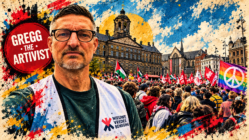




On NATO, Power, Defence, and Accountability
Recently, I’ve been posting some strong critiques of NATO.
And someone asked me directly: “So… are you anti-NATO?”
It’s a fair question—but like most things, it’s not black and white. My position is more personal, more complex, and rooted in the lived experience of family.
No, I’m not anti-defense. I’m not naive enough to think that if we—those of us in the North Atlantic Treaty Organisation member countries—simply choose peace, everyone else will lay down their weapons. The world has scars, and history has consequences. Even if we change our posture, we can’t expect those we’ve harmed—directly or indirectly—to trust us overnight.
And let’s be honest. NATO hasn’t just been “poking the bear” when it comes to Russia, It has a well-documented history of controversial interventions. Many of which have resulted in civilian harm and long-term instability. From Afghanistan to Libya, thousands of innocent people have paid the price for decisions made far from their borders. *
So, am I okay with what NATO has become?
No. Not at all.
It frustrates me—deeply—that an alliance built on principles like collective defense and peacekeeping has repeatedly acted outside its own framework. That it says one thing and does another. That it fuels conflicts instead of preventing them. And that it rarely holds itself accountable.
There was a moment—after the Cold War—when NATO could’ve been reimagined. Not as a force for escalation, but as a platform for peace building, dialogue, and mutual security. That moment passed. Since then, leaders like Mark Rutte have been calling for defense spending increases to 5% of GDP—often using fear and vagueness instead of clarity and reason.
I guess what I’m saying is: I’m not against defense.
I oppose fear being used as a tool of persuasion. Institutions that fail upward—while millions pay the price—must be called out. And the military-industrial complex that profits from perpetual insecurity? I’m done accepting that as normal.
So, Am I anti-NATO?
No—not in some blanket, oversimplified way.
I’m watchful; however hypocrisy, fear-driven politics, and an alliance that escalates while calling it “protection”—none of that sits right with me. We need to ask harder questions. We need to demand transparency.
And we need to hold NATO accountable—because too much power, without oversight, leads us away from peace.
Explore More:
- NATO Video Series: Critical Reflections
- Is NATO Still a Defensive Alliance?
- The 5% GDP Push and the Military-Industrial Complex
Recommended External Reading:
- Cato at Liberty – “Just Say No to NATO Expansion”
- NATO’s Founding Treaty and Guiding Principles
- The Guardian (Opinion) – “Europe does not have to choose between guns and butter”
* NATO Fact-Check and Critical Notes:
- ✅ “Poking the bear” regarding Russia — A fair and widely acknowledged criticism. NATO’s eastward expansion since the 1990s (including into former Soviet-aligned states) has been cited by many scholars (including U.S. diplomats like George Kennan, Jack Matlock, and scholars like Mearsheimer) as unnecessarily provocative toward Russia.
- ✅ NATO’s history of questionable actions — Also accurate. The alliances interventions in Kosovo (1999), Afghanistan (2001–2021), and Libya (2011) are particularly controversial. Civilian casualties, regime destabilisation, and long-term regional consequences have all been documented and criticised by human rights organisations, academics, and even internal reviews of the military alliance.
FAQ’s
Is Gregg Hone (aka Gregg the Artivist) anti-NATO?
No. Despite what may sound like a contradiction to his NATO critiques, Gregg Hone has made his position clear:
“I’m not anti-defense. I’m not naive. I know that just choosing peace doesn’t make everyone else drop their weapons. The world has scars—and not everyone heals at the same pace.”
Gregg’s work critiques NATO not out of hostility, but from a place of accountability. His aim is to challenge systems of power when they stray from their own stated values—like diplomacy, peacekeeping, or democratic legitimacy.
He believes it’s both possible and necessary to question militarised structures without aligning with authoritarian regimes or conspiracy-driven rhetoric. As an artist and climate justice advocate, his focus is on reimagining global security through dignity, cooperation, and long-term peace—not fear, domination, or extraction.
Critique, in this context, is a form of care. And it’s essential if we want to build systems that truly serve the people and the planet.
Why critique NATO at all?
Because critique is a vital part of democracy. Institutions with immense power—especially those involved in military force—must be held accountable to the values they claim to uphold. NATO calls itself a defensive alliance rooted in diplomacy and collective security. But its actions often tell a different story: escalating militarisation, selective concern for human rights, and silence in the face of injustice.
Gregg’s work challenges these contradictions not to tear things down, but to ask: Are we living up to our own principles?When diplomacy is sidelined in favour of posturing, or when “security” comes at the expense of lives, land, and liberty, we have a responsibility to speak out. That’s not anti-NATO—it’s pro-truth, pro-justice, and pro-accountability.
What does peace activism look like in practice?
Peace activism isn’t passive—it’s bold. It means imagining alternatives to war before we justify more weapons. It means questioning narratives that normalise violence and redirecting resources toward what actually keeps people safe: education, healthcare, climate resilience, and human dignity.
For Gregg, peace activism means storytelling that disrupts harmful norms. It means asking uncomfortable questions and building bridges across difference. It’s about showing that peace isn’t a fantasy—it’s a practice. And it starts with choosing honesty over convenience, connection over fear, and long-term wellbeing over
Is this critique anti-American or anti-Western?
No. This critique isn’t about tearing down a country or a culture—it’s about questioning systems of power when they cause harm or abandon the values they claim to uphold. Challenging NATO’s militarised approach or the silence around climate impact doesn’t make someone anti-American or anti-Western. It makes them engaged, awake, and willing to hold space for accountability.
Gregg’s work is rooted in empathy, justice, and truth-telling—not in conspiracy, nationalism, or ideological extremes. It’s possible to value the ideals of democracy, freedom, and cooperation while also questioning the ways they’re distorted or weaponised by those in power.
In a world facing collapse, we don’t need blind loyalty—we need courageous honesty. And that means asking hard questions, even of the institutions we’re supposed to trust.
About ‘Gregg the Artivist’
Gregg Hone is an artist, activist, and climate storyteller based in the Netherlands. Blending creative expression with critical thinking, his work challenges dominant narratives and explores the intersections of power, peace, and justice. Through video, public speaking, and grassroots projects, Gregg invites others to reflect deeply, question boldly, and imagine more compassionate systems beyond fear and control.
Want to collaborate?
If this series moves you, challenges you, or raises more questions—reach out. I’m open to dialogue, media invitations, creative partnerships, and continuing the work.
