
Rethinking What We Call Realistic
On Sunday morning, I had a call with my husband, who is currently abroad. It was his ‘gentle check-in’ to see that I was still going to the Stop de Oorlogskoorts (Stop the War Fever) National Peace Protest being held later that day, as planned.
I was. And although he was disappointed he would not be able to show his support, he was happy to hear I was still attending. He expressed his concerns about how the week’s contested media coverage around the protest might impact the turnout.
Honestly, I was unaware of the week’s media discussions. I was on my routine ‘week off the news cycle’, a practice I started doing each month for my own sanity.
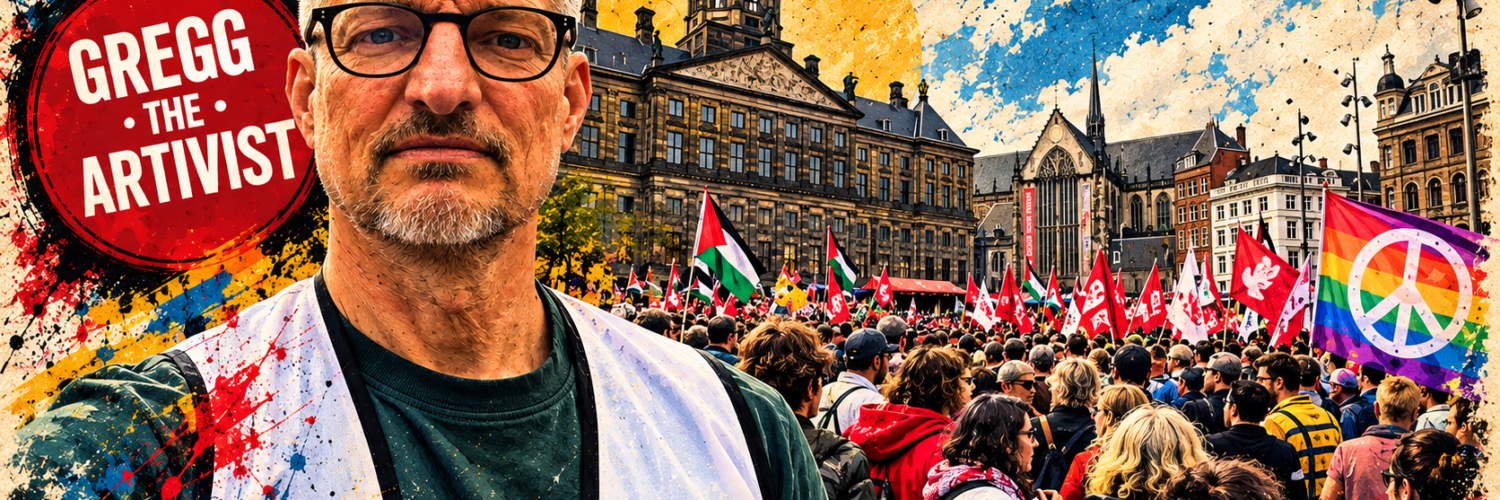
So, as you can imagine, I spent the rest of the morning catching up on what had been reported before heading to Amsterdam’s Dam Square to join thousands of ordinary people, from children to great grandparents.
Pretty soon after arriving, I was greeted by a friend and colleague of my husband and was happy to put on a De Nieuwe Vredesbeweging vest and volunteer to hand out flyers.
As I navigated my way through the crowd, I couldn’t help but reflect on how such a peaceful, caring group of people, simply wanting a more just future, could have attracted such notable criticism over the previous week.
Leading up to the protest, the peace movement’s manifesto had attracted considerable attention. There were columns, radio discussions, television coverage, and it even stirred debate in Parliament.
The manifesto calls for a “change of course away from militarisation and escalation and towards peace, diplomacy, social security and an independent peace policy”.
Yet the route to peace remains highly contested. Critics from different directions questioned how realistic the manifesto was.
Some argued that calls for de-escalation fail to adequately confront the reality of Russia’s invasion of Ukraine. On NPO Radio 1, Volt parliamentary leader Laurens Dassen argued that Putin continues to escalate the war in Ukraine, concluding: “Het is naïef om te denken dat hij gaat stoppen.” (Translation: “It is naïve to think that he [Putin] is going to stop.”)
Others questioned how diplomacy can succeed without military deterrence. Writing in de Kanttekening, political scientist Ronald Smallenburg argued that military strength is necessary to bring peace closer, concluding bluntly: “Afschrikking werkt, pacifisme niet.” (Translation: “Deterrence works, pacifism does not.”)
And sure, these are no small questions.
And to be fair, media coverage widened after the protest, including reporting from the ground and conversations with those who attended.
But at times, this criticism seemed to leave little room for another reality: that people within the movement understand perfectly well that war is real. Some have lived through it. Some have lost people to war.
People understand that people are dying. It is splashed across our media daily. They understand that Ukraine isn’t some abstract argument. And they too live with the fears, like many others across Europe, about security and what might happen next.
Of the many people I spoke to, no one was pretending war wasn’t real. In fact, people were able to articulate the complexities of their understanding. One woman told me, “No-one is fooled that we can be here today and think ‘job done’. We need to think, how do we get from here to there?”
Those discussions continued with various people. Everything from: what does meaningful diplomacy even look like? To: how do we create security without endlessly escalating insecurity? One man raised the reality of what happens when one side refuses to negotiate.
The ‘unrealistic’ expectation
This narrative of “naïve” and “unrealistic” in the media really began to bother me.
Historian Hidde Bouwmeester wrote a piece titled “The peace movement wants a sustainable peace for Ukraine, but does not explain how we are going to achieve it.” His central challenge is that negotiation requires leverage. So, if military support is the leverage the manifesto proposes to remove, what replaces it?
He identifies a gap. And I think it’s a real one.
What I’m less certain about is his conclusion: that as long as the movement cannot explain what would replace military support as leverage against Russia, its call for a just and sustainable peace remains, in his words, “vaag en idealistisch” (translation: “vague and idealistic”).
The answer? I don’t know.
In 40 years of attending protests, I don’t recall anyone having presented the solution wrapped up neatly with a bow.
A protest is the beginning of a conversation. It’s certainly not the end of a negotiation.
And need we be reminded… we vote with less.
So it is ironic that somehow, when the subject is peace, imagining something different has itself begun to feel fearful.

The fear narrative
I’ve written a lot in the past about fear narratives. And right now, we are living with a lot of fear.
Fear of Russia. Fear of escalation. Fear of what happens if Ukraine loses. Fear of what happens if Europe isn’t prepared. Fear about what kind of world the next generations are inheriting.
I’m not questioning those fears. Some are undoubtedly justified.
But there’s an age-old challenge we all face: what happens when fear becomes so dominant that it begins defining the boundaries of what we’re allowed to imagine?
Simply put, nothing new.
And this brought me back to two words that had appeared repeatedly in the criticism I had been reading: realistic and idealistic.
We use ‘realistic’ almost as a victorious word. To be a realist is to be sensible, practical, grounded in the world as it is. Idealism is something softer. Abstract. Nice perhaps, but not quite serious.
And that bothers me.
Because it reinforces this idea that military preparedness belongs to the realm of realism, while diplomacy and peace-building belong to idealism.
I don’t think acknowledging genuine threats means we have to allow those threats to determine the entirety of our response.
Hope in uncertainty
As I walked around handing out flyers, there were, of course, the visible seasoned activists. But what gave me such hope was that, for the most part, these ordinary people didn’t look like activists at all.
I didn’t encounter thousands of people who believed peace would be easy. If anything, quite the opposite. And that’s a far cry from being “naïve” or “unrealistic”.
Again and again, the conversations I was having included uncertainty. Something I write about, and wrestle with, a lot.
I left with an overwhelmingly positive feeling that peace is difficult. Peace is complicated. Peace will demand courage, imagination and uncomfortable conversations.
Thousands of us stood together in Amsterdam saying that despite all of that complexity, peace remains something worth pursuing.
And yet, still they came.
And I was inspired by the belief that we should never allow the complexity of achieving peace to convince us that peace itself is naïve.
How do you see things?
I’d genuinely love to hear your perspective.
Share your thoughts in the comments below.
FAQ's - Peace and Naivety
What is Stop de Oorlogskoorts?
Stop de Oorlogskoorts, or “Stop the War Fever”, is a Dutch peace initiative calling for a change of direction away from militarisation and escalation and towards peace, diplomacy, social security and an independent peace policy. Its National Peace Protest brought thousands of people together in Amsterdam in September 2026.
What is De Nieuwe Vredesbeweging?
De Nieuwe Vredesbeweging, or “The New Peace Movement”, is a Dutch peace movement bringing together people and organisations concerned about war, militarisation and European security, while advocating greater attention to diplomacy, peacebuilding and alternatives to military escalation.
Is calling for peace in Ukraine naïve?
Critics of contemporary peace movements argue that diplomacy without sufficient leverage may not persuade Russia to negotiate or compromise. Peace activists raise a different question: whether acknowledging those difficulties should prevent societies from exploring diplomacy, de-escalation and other approaches to achieving a just and sustainable peace. This READ explores that tension rather than claiming there is a simple answer.
Why is peace sometimes described as unrealistic or idealistic?
Peace proposals can be described as unrealistic when critics believe they underestimate security threats, power imbalances or the difficulty of negotiating with an unwilling party. But words such as “realistic” and “idealistic” also shape how different responses are perceived. This article asks why military preparedness is often associated with realism while diplomacy and peacebuilding can more readily be characterised as idealistic.
What was the National Peace Protest in Amsterdam about?
The National Peace Protest in Amsterdam called for greater emphasis on peace, diplomacy and social security amid growing concern about war and militarisation in Europe. The demonstration also prompted debate about Ukraine, military deterrence, European security and what meaningful diplomacy could look like.
Can you support Ukraine while questioning military escalation?
These positions are not necessarily mutually exclusive. Debates within peace and security movements include questions about Ukraine’s right to self-defence, military assistance, deterrence, diplomacy and the risks of further escalation. The disagreement is often less about whether peace is desirable than about how a just and sustainable peace could realistically be achieved.




For some reason, reading your post, I couldn’t help but think of Dag Hammarskjöld. He once wrote: ‘The pursuit of peace and progress cannot end in a few years in either victory or defeat. The pursuit of peace and progress, with its trials and its errors, its successes and its setbacks, can never be relaxed and never abandoned.’ Brave words, spoken just six months after the Korean War.
It shows me he wasn’t naive, but deeply realistic about that endless process of trial and error. To me, it feels like all the experts today are quick to applaud him as a Cold War peacefighter, yet they act as if anyone arguing for peace today is just being foolish. And it makes me reflect on how those same experts praised the decisions when Obama or the EU won the Nobel Peace Prize…
Thank you for this. I really appreciate the Hammarskjöld quote, particularly the idea that the pursuit of peace includes trials, errors and setbacks. Perhaps recognising that uncertainty is not naïvety at all, but part of taking peace seriously. Lots for me to think about here.
[…] the last few weeks writing about peace, I’ve found myself somewhere I hadn’t quite expected: increasingly aware of what it means to […]