
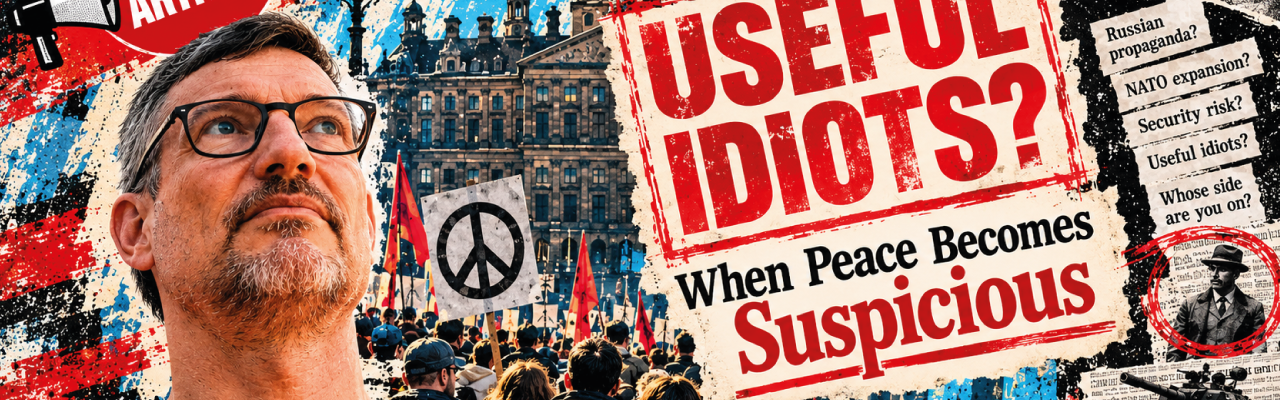
Useful idiots.
Naïve and idealistic. Two words that had barely left my mind after last week’s READ when another two, “useful idiots”, came knocking, determined to take up residence.
And despite my best efforts, I haven’t managed to evict them.
Last week, writing about the national peace protest, Stop de Oorlogskoorts, I found myself bothered by how easily calls for peace can be dismissed as naïve or idealistic. Particularly when preparing for war is increasingly presented as the sensible, responsible thing to do.
So I found myself asking:
Why is imagining peace considered less realistic than preparing for conflict?
Yet less than a week later, I’m beginning to wonder whether I’d been asking the wrong question. Because as I followed the conversations unfolding after the demonstration, something else began bothering me.
Maybe peace isn’t simply becoming unrealistic. Maybe it’s becoming suspicious.
Putin’s useful idiots
A few days after the demonstration, Dutch security expert Rob de Wijk published a column referring to “Putin’s useful idiots on Dam Square.”
Now I have to admit, I knew his name, but didn’t exactly know much about him. So, as I do, I did a little digging.
It turns out De Wijk isn’t some anonymous social media troll. He’s the founder of The Hague Centre for Strategic Studies and one of the Netherlands’ most recognisable commentators on defence and international security.
I’m not questioning whether his arguments deserve to be taken seriously. They do.
He argues that protesters are falling for Russian propaganda. That claims about NATO expansion and Western responsibility for the war in Ukraine echo narratives promoted by Moscow. That European countries joined NATO voluntarily because they feared Russian domination. And that reducing military preparedness now could leave European societies dangerously exposed.
Fair enough, those are arguments worth debating. Which is precisely why I find those two words so troubling.
Useful idiots.
I mean really? Calling people “useful idiots” doesn’t challenge someone’s argument. It suggests that whatever their intentions, they’re too naïve to recognise whose interests they’re actually serving.
In other words: You may believe you’re acting for peace, but you’re actually serving somebody else’s interests. You’re simply not perceptive enough to realise it.
Burn!
And suddenly, those calling for peace are no longer people with whom the expert disagrees. They’re simply dupes.
And apparently, end of conversation!
Who pays for our peace?
Those of us advocating for peace cannot expect to be immune from scrutiny simply because our objective is peace.
Russia invaded Ukraine, and Ukraine is defending itself against that aggression. Any call for de-escalation has to confront that reality head-on. It’s about far more than telling two sides to stop fighting. Yet one criticism I encountered this week particularly struck me:
Pacifism can make the victim pay. Sadly, it can. And that’s a serious challenge.
I don’t have an easy answer to that. And neither can the peace movement afford to avoid the question.
The wider conversation raises some tough questions. What does diplomacy look like when an aggressor refuses to compromise? What responsibility does Europe have towards Ukrainians defending their country? Does deterrence sometimes prevent rather than provoke conflict? Could reducing European military capacity actually make some countries less safe?
As I wrote in last week’s article, many of these questions arose in conversations with fellow protesters.
These aren’t inconvenient questions to brush aside as militarist thinking. They belong inside the conversation about peace.
Maybe some people on Dam Square do underestimate Putin. Maybe some repeat arguments also promoted by Russian propaganda. And maybe the peace movement’s manifesto would make Europe less rather than more secure.
But if I could say one thing to De Wijk, it would be this:
Then go ahead and challenge those ideas. Show where the evidence fails. Explain why another strategy would work better. Bring competing visions of security into public debate.
De Wijk has the expertise, experience and platform to take the strongest version of the peace movement’s argument and demonstrate why he believes it fails.
Yet alongside his arguments, he opted for a sensationalised label:
“Putin’s useful idiots.”
When that language comes from someone whose expertise gives him an amplified voice in our national conversation, I think we should expect better.
Frankly, Rob, that’s beneath the expertise you bring to this conversation.
Seeing Russia everywhere
Yet that wasn’t the only thing competing for my attention this week. There was the whole De Nieuwe Vredesbeweging logo “scandal”.
Wessel de Jong, an NOS journalist, posted an image of the movement’s logo on social media, observing that its intersecting arrows resemble the Cyrillic letter Ж. He saw similarities to Russian military markings and even associated it with the Russian word жулик: crook.
Similarity is a far cry from evidence of intent. A Cyrillic letter used across several languages is not evidence of Russian allegiance. Two intersecting arrows do not become Russian because someone recognises a Russian shape within them.
Yet somehow we’ve arrived at a point where even the peace movement’s logo is being searched for traces of Russia.
Sorry Wessel, with due respect for your journalistic familiarity with Russia, but this feels more provocative than useful.
Furthermore, there was the missing movement.
De Rode Draad, an NPO Radio 1 programme, asked: “What does the current peace movement look like?”
Three panellists discussed it. Nobody from De Nieuwe Vredesbeweging was among them.
An interesting editorial choice.
A pattern worth questioning
I’m not suggesting these incidents prove some grand media conspiracy against peace activists. I doubt we’d gain anything by jumping to that conclusion.
But collectively, something feels off. Something worth our attention.
Why has Russia so quickly become the lens through which Dutch peace activism is being interpreted?
For me, this matters because the conversation isn’t happening on a level playing field.
Interrupting inevitability
Across Europe, our political vocabulary is increasingly normalising military readiness, rising defence budgets, resilience and strengthening Europe’s capacity to defend itself. And there are serious reasons for this.
But I can’t help thinking about how these narratives shape what societies regard as possible, necessary and realistic.
It’s that age-old idea: when we hear something often enough, we begin to believe it. And in this case, the narrative has begun to sound less like one possible response and more like the only responsible response.
For me, that’s where activists play an important role. It’s not necessarily about being right. It’s about interrupting inevitability.
We need to ask questions that aren’t part of the conversation, whether by design or otherwise. We need to imagine alternatives and challenge the assumption that the choices presented to us are the only ones available.
The responsibility goes both ways
I believe De Nieuwe Vredesbeweging acknowledges that it has work to do.
Its national demonstration brought several thousand people onto the streets and became newsworthy before the protest even took place. But to become a credible voice in the national conversation, a manifesto alone won’t be enough.
When critics identify genuine weaknesses or contradictions, the movement needs to confront them.
But the responsibility goes both ways.
People with established platforms have power too. Politicians, journalists, think tanks and security experts. And with an amplified voice should come an equally strong responsibility to distinguish criticism from insinuation.
If a peace organisation is influenced by Russia, demonstrate it.
If its claims reproduce Russian disinformation, identify those claims and show why they are false.
If its proposals would make Europe more dangerous, make that argument.
Democracy
I was at the demonstration, speaking with people who were worried. I didn’t agree with everything I heard, but how could I? Thousands of people have thousands of versions of the world.
That is democracy, after all.
People are entitled to believe the movement’s calls are profoundly mistaken. But reducing people to “useful idiots” should concern us, especially when those words come from voices with far more reach than those standing next to me on the square.
When peace becomes suspicious
I am clearly not neutral about peace, nor do I want to be. I believe peace is something worth pursuing. That doesn’t mean I know how to achieve it. And it certainly doesn’t mean pretending that aggression disappears if we refuse to prepare for it.
But I believe societies need people willing to question the assumptions of their time. Artists, activists, journalists, peacebuilders and ordinary people showing up to a demonstration.
As I write this article, I’m realising that my concern isn’t simply the danger of peace being regarded as naïve.
It’s what happens when questioning militarisation starts to raise questions about whose side you are on.
We’re questioning the people who dare to have them.
And I think that’s when peace doesn’t merely become unrealistic.
It becomes suspicious.
How do you see things?
I’d genuinely love to hear your perspective.
Share your thoughts in the comments below.
FAQs: When Peace Becomes Suspicious
What does “useful idiots” mean in the context of peace activism?
The term “useful idiots” describes people who may unintentionally advance another person’s or government’s interests without recognising it. In debates about peace activism, it can suggest that campaigners are inadvertently supporting an aggressor, even when their stated intention is to prevent conflict. The article questions whether this label encourages meaningful debate or dismisses legitimate political disagreement.
What was the Stop de Oorlogskoorts demonstration?
Stop de Oorlogskoorts (“Stop the War Fever”) was a national peace demonstration held in Amsterdam on 27 September 2026. Organised by De Nieuwe Vredesbeweging, it brought several thousand people together to protest increasing militarisation and advocate alternative approaches to peace and security.
Does questioning militarisation mean opposing Ukraine’s right to defend itself?
No. Questioning military spending, deterrence or European security policy does not automatically mean opposing Ukraine’s right to defend itself against Russian aggression. However, peace movements must address difficult questions about sovereignty, occupation and the consequences of reducing military preparedness. Supporting peace does not remove the responsibility to consider how proposed policies affect people facing aggression.
Why is democratic dissent important when peace becomes suspicious?
When peace becomes suspicious, people questioning military policy risk having their motives or loyalties challenged instead of their arguments examined. Democratic dissent allows citizens to question government priorities, challenge prevailing assumptions and propose alternatives. Those ideas should remain open to rigorous criticism, but accusations of foreign influence require evidence.





Challenging militarisation isn’t the same as choosing Russia. We can take Ukraine’s defence seriously and still debate diplomacy, deterrence and the costs of higher military spending.
Thank you Niels! That’s exactly the kind of nuance I hoped the article would encourage. These aren’t mutually exclusive conversations, and we should be able to explore the difficult questions without being pushed into opposing camps. I really appreciate you adding your perspective.
Calling for peace is easy but explaining how to secure it when an aggressor refuses to compromise is harder. You are right to defend open debate but you should also make clear what the movement proposes for Ukraine’s safety and sovereignty. I think you need to give more information about this.
Thank you for raising this. I agree that Ukraine’s safety and sovereignty cannot be overlooked. But I would challenge the idea that peace movements must have a fully developed solution to a conflict before they can legitimately question the current approach. Governments, diplomats and military experts haven’t resolved these questions either. Activism has an important role in challenging assumptions, asking uncomfortable questions and imagining alternatives. That doesn’t mean peace movements are beyond criticism, but I don’t think they should be expected to have all the answers. I explore this distinction further in my earlier article, Peace: A Far Cry from Naivety. I’d be interested to hear your thoughts on that perspective.
I agree. Criticise the claims, test the evidence, and explain the alternatives. But suspicion isn’t a substitute for argument. Nice article.
Thank you! I think that’s exactly the distinction we need to make. We should be able to challenge each other’s arguments rigorously without questioning each other’s motives. That’s where a more constructive conversation can begin. Really appreciate you reading and sharing your thoughts!
I agree with you that “useful idiots” is a dismissive label. Also suspicion shouldn’t replace evidence. At the same time, it would be helpful if the new peace movement address how their proposals would protect Ukraine and stop further aggression.
Thank you! I agree that protecting Ukraine and preventing further aggression are essential questions. But I also wonder whether we’re expecting peace movements to provide complete solutions to problems that governments, diplomats and military experts themselves struggle to resolve. Surely part of activism’s role is to challenge prevailing assumptions, raise questions and open up possibilities that might otherwise be overlooked? That doesn’t exempt peace movements from scrutiny, but it does raise questions about what we expect activism to achieve. I explored this further in my earlier READ, Peace: A Far Cry from Naivety. I’d love to hear what you think!
Peace activism deserves tough question but its arguments should be answered with evidence, not dismissed with labels.
Calling protesters “useful idiots” risks shutting down the democratic debate we need.
The public approach to peace is being drawn into taking sides. It’s upsetting and unfair.
Thank you. I think what’s particularly troubling is how quickly the conversation becomes about whose side you’re on, rather than the questions being raised. We should be able to challenge peace activism, including its difficult contradictions, without treating the pursuit of peace itself as suspicious. I really appreciate you sharing this.