
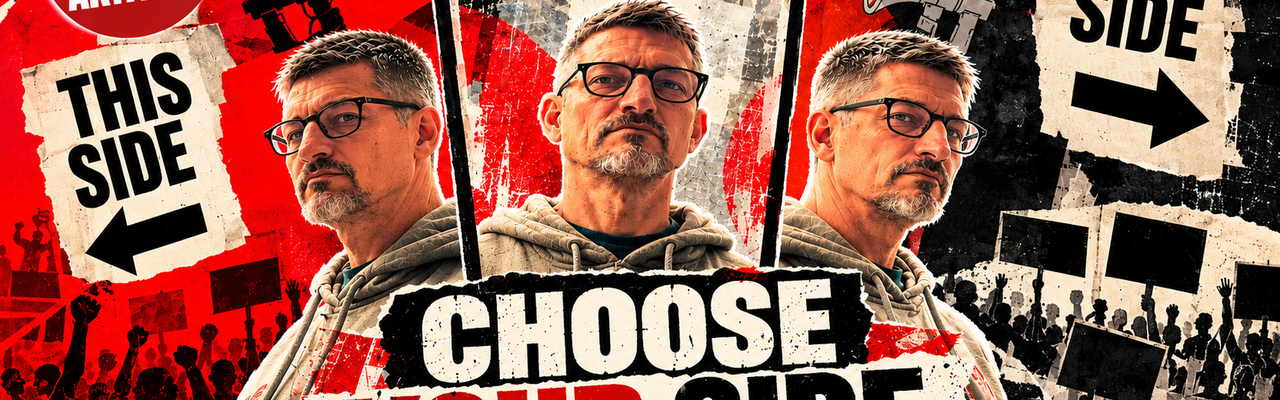
Choose your side
Following the last few weeks writing about peace, I’ve found myself somewhere I hadn’t quite expected: increasingly aware of what it means to live within polarisation.
As uncertainty about our future intensifies, along with the debates about what’s driving it, we’re constantly being told to choose a side.
It’s led me down all sorts of rabbit holes, questioning my own beliefs, challenging my assumptions and reconsidering where I stand on an exhausting list of issues facing our world.
And to be honest, at times it’s been more than a little frustrating. It’s been uncomfortable, even.
Yet, as I write this, I realise something unexpected also happened along the way.
Rather than weakening my convictions, these experiences have helped me understand them more deeply. I’ve found myself giving time and attention to questions I thought I’d already explored, discovering new perspectives and developing a deeper appreciation of why I believe what I believe.
And for someone who already spends a considerable amount of time questioning himself, that feels significant.
Yet more and more, I’m encountering an expectation that questioning suggests uncertainty. That uncertainty somehow signals a weakness in conviction. Or that challenging one side automatically places you in the opposing camp.
And I find it disconcerting that we’ve become so uncomfortable with people thinking out loud.
The comfort of certainty
The other evening I watched a clip from a podcast featuring a particularly charismatic speaker.
He was super engaging for many reasons. He was articulate, passionate and spoke about issues I care deeply about. And much of what he said resonated with me.mBut his argument also left me feeling uneasy.
According to him, there were only two sides. You were either on one or the other. No third way. No room for ambiguity.
His language was powerful, often sensational, and he had a remarkable ability to make a complicated issue seem straightforward. Honestly, I felt a pinch of envy.
I understood why people found him compelling. I did too. But what made me uneasy also made me curious. I started to wonder, what happens when we communicate complex issues with such absolute certainty? And just as importantly, what does that encourage in the people listening?
So I opened the comments.
People were literally ‘gushing’ over his clarity. They praised his willingness to speak his mind and for saying what needed to be said.
But among the comments I read, there was remarkably little, if any, questioning of the argument itself. Now, of course, I hardly believe a social media comment section represents everyone who watched the clip. But this clip had gone viral, and there was a lot of interaction that was hard to ignore.
And as I continued reading, that uneasy feeling began to grow. It wasn’t the people who disagreed with him. It was this black hole where critical engagement should have been, particularly among those who agreed.
And I thought to myself, this is where the real challenge begins.
It’s relatively easy to question people whose views we oppose. But how often do we question those who appear to speak for us?

I have chosen a side
I think, or feel rather, I should make something clear.
I’m not at all trying to find a comfortable position between opposing political camps. And I am far from positioning myself above polarisation, looking down on everyone else. Trust me. I’m living in the middle of it, with all the frustration, anger, biases and contradictions that come with being human.
And I have chosen a side.
I choose life. All life.
I believe in fundamental rights, human dignity and a world where people and nature are not endlessly exploited for the accumulation of wealth and power.
I believe we have an economic and political system that continues to extract from finite human and natural resources. It concentrates extraordinary wealth while undermining the conditions on which life, all life, depends.
I see a class struggle within that system and the enormous inequalities it produces.
These, of course, aren’t neutral positions. But choosing what I stand for doesn’t mean automatically agreeing with every argument, strategy or action proposed by those who share my values.
I can and do support a movement’s ambitions while questioning its methods. And I don’t pretend to have all the answers to overcoming the injustices I see. Nor does listening to someone whose worldview differs fundamentally from mine mean surrendering my own.
When uncertainty becomes uncomfortable
I know I’ve expressed this time and again. Apologies to my regular readers.
We’re living through extraordinary uncertainty. War, ecological breakdown, economic insecurity and political instability are changing how we experience the world.
It’s exhausting.
For me, it’s little wonder there’s such growing discomfort with nuance.
Because when everything feels uncertain, clear answers can offer reassurance. Someone who confidently explains what’s wrong, who’s responsible and what must happen next offers something that complexity rarely provides. Certainty, a sense of belonging, and even relief. I can understand the attraction. I sometimes feel it myself.
But when I see our desire for certainty becoming stronger than our willingness to question, I begin to worry. Particularly when asking an uncomfortable question becomes an act of disloyalty.
And then there’s an important complication here. Questioning everything isn’t necessarily a virtue either.
My experiences in climate activism have taught me that uncertainty can also be used to frustratingly delay and even obstruct change. For decades, we’ve watched the fossil fuel industry promote doubt about climate science, helping delay meaningful responses to an ever-growing body of evidence. They simply didn’t need to prove that climate change wasn’t happening. Creating sufficient uncertainty was enough to sustain a seemingly never-ending cycle of debate.
And climate movements have faced their own communication dilemmas.
How do we communicate urgency without relying entirely on fear? And how do we acknowledge genuine scientific uncertainty without undermining well-established findings?
Not easy questions, and certainly not ones with easy answers. But they remind me that nuance doesn’t mean pretending every argument has equal merit.
Sometimes the evidence is overwhelming, and sometimes taking a clear position is necessary.
I believe the challenge isn’t choosing between certainty and uncertainty, but recognising when each is justified.
The temptation to shout louder
When I started writing this article, I was really fired up to write something far more provocative. Something sharper, angrier and more confrontational. A few sensational words thrown in for good measure.
It would have been easy to state my argument, identify a convenient villain and deliver my conclusion with absolute confidence.
Maybe it would attract more attention. I’m not going to lie. The temptation is certainly there.
Because I’m really angry about injustice. I’m frustrated by the continued destruction of our natural environment, the suffering caused by war and the extraordinary inequalities we’ve come to normalise.
Sometimes I want to shout so loud. I want to respond to criticism with exactly the same force and certainty that I find so troubling in others.
But then I have to ask myself what I’m actually trying to achieve.
And strangely enough, that question can feel quite deflating. I become disappointed. As though I’m giving in or holding back what I really want to say. Worse, I somehow feel less authentic by choosing my words more carefully.
Because the anger and frustration are real. And I don’t want to pretend otherwise. But I also recognise that the way I communicate can reproduce the very conditions I’m trying to challenge.
So where does that leave me?
How do I express genuine anger without allowing it to become the only thing people hear?
How do I challenge an argument forcefully without turning the person making it into an enemy?
And how do I remain open to other perspectives without feeling that I’m compromising my own?
And typically, I don’t have a neat answer.
The one thing I know with certainty is that I’m discovering wanting to communicate differently and actually doing it are two very different things.
⸻
Funny enough, these past few weeks have reminded me why I began writing READ. Not to become an authority on every subject, but to share the experiences, questions and contradictions shaping how I understand the world.
Climate, social and environmental justice, and peace matter to me. They always will.
Sometimes I write with conviction, sometimes with uncertainty, and more often than not with something still to learn. I really hope you’ll challenge me and offer perspectives I haven’t considered. Because I want to keep listening.
Lately, I’ve wondered whether our insistence on choosing sides is making it harder to ask the questions that might actually help us move forward.
I’m still figuring that out myself.
Some days with curiosity. Other days with considerably less patience.
But I’m trying.
How do you see things?
I’d genuinely love to hear your perspective.
Share your thoughts in the comments below.
Frequently Asked Questions About Political Polarisation
What is political polarisation?
Political polarisation describes the growing division between people or groups with opposing political beliefs and identities. It can make disagreement more difficult, particularly when people begin to see those with different views as opponents rather than individuals worth listening to.
In this READ, I reflect on how that pressure to choose sides affects my own thinking and communication.
Does questioning your beliefs mean your convictions are weak?
I don’t believe so. In fact, my recent experiences have suggested quite the opposite.
Questioning my assumptions hasn’t necessarily changed what I stand for. But it has helped me understand why I hold certain convictions and recognise where my understanding might still be incomplete.
For me, that’s part of learning rather than a sign of weakness.
Is taking a neutral position the answer to political polarisation
Not necessarily. I’m certainly not suggesting we should remain neutral in the face of injustice.
I have strong convictions about human dignity, fundamental rights, environmental justice and the conditions needed to sustain life.
But I don’t believe those convictions require me to agree with every argument or action proposed by people who share my values.
How can we disagree without making each other enemies?
That’s something I’m still trying to figure out.
I know how tempting it can be to respond to criticism with anger or certainty, particularly when the issues matter deeply to me.
But I’m learning to question whether the way I communicate helps people engage with an argument or simply pushes them further away.
I don’t always get that balance right. And I suspect I’ll continue learning.







Hi Gregg, an attempt 😅
– it seems your reflection is not about facts but (foremost) about feelings
– feelings about the rejection or (threat of possible) cancelling of your opinion / the opinions in the general debate
– this impact brings on the questions: how important is an opinion, what does my opinion mean to me?
– I listened a podcast “disagreeing well” that came up with the theory, as i understood it, that in the modern individualistic society people construct their (group-) identity around their opinions (instead of being born in a community); the opinion is therefore closely connected to someone’s chosen personality
– I would add to that my speculation that we are in a society where there is a big stress on (the moral right) to be seen and heard
– the rejection of an opinion can, in that light, become something to be weaponized, and the latent consciousness of this power-element could cause feeling of unease?
– or demotivated disappointment
However, on the factual side, i guess feelings about opinions would matter less when one would see more actual progress achieved – and disagreeing with people on your own side would matter less. Which brings me to the thought that it is important to keep in contact with examples where progress is made – i assume it makes you feel better 😊
Hello Chris,
Thanks for taking the time to explore this! 😅
I think you’ve raised something really interesting about how closely our opinions can become tied to our identity and sense of belonging. Perhaps that’s part of why questioning people on our own side can feel so uncomfortable.
I’d make one small distinction, though. While my reflection certainly explores feelings, it’s not so much about the fear of having my opinions rejected or cancelled. It’s more about how we engage critically with arguments, particularly those we instinctively agree with.
And I like your point about staying connected to examples of progress. I think that’s important, especially when so much of what we encounter can feel overwhelming.
Although I’m curious whether disagreement within our own movements becomes less important when progress is being made, or whether it’s actually part of how we make that progress possible?
You’ve given me something else to think about. Thank you! 😊
Thanks for writing this. It read very honest which is rare on this topic. The comment-section moment is the strongest part. Noticing the “black hole where critical engagement should have been” among people who agreed is a sharp observation, and your line about how often we question those who appear to speak for us is the real heart of the piece. I would have built the whole article around it. Enjoyable annd thoughtful article.
Thank you! I really appreciate you taking the time to read it and share such thoughtful feedback.
It’s interesting that you picked up on that particular moment, because it really stayed with me too. And you may well be right that there’s an entire article in that observation alone!
I suppose I was also trying to explore my own contradictions along the way, particularly how easily I can fall into the same patterns I’m questioning in others.
But you’ve given me something to think about for a future READ. Thanks again! 😊
Hi Gregg,
This is an incredibly refreshing read. Your observation about the black hole where critical engagement should have been is spot on. In a hyper-polarized digital world, agreement is often treated as a loyalty test, if you pause to question a detail, you are immediately accused of betraying the cause or playing for the opposing team.
Your point about climate activism adds a brilliant layer of nuance. It highlights a massive paradox we are all living through: to build public and political will, movements feel forced to project absolute, unshakeable certainty. Yet, to actually solve highly complex, systemic problems, we desperately need room for error, adaptation, and open-minded questioning.
It makes me wonder: how do we design spaces, whether online or in our local communities where people feel safe enough to drop their defensive armor and actually “think out loud” together without the fear of social exile?
Thank you for refusing to stop questioning, even after choosing your side.
Thank you for such a thoughtful response! You’ve really understood one of the issues I’ve been wrestling with, particularly that paradox between communicating urgency and allowing space for uncertainty.
And I love your question about how we create spaces where people feel comfortable enough to think out loud.
It’s something I’ve been exploring through my own experiences with community gatherings and facilitation. Interestingly, I touched on a similar question in an earlier READ about inviting our critics into the room.
I don’t think there’s a simple answer, but perhaps it starts with making disagreement feel less like a threat and more like an opportunity to understand something we might otherwise have missed.
Of course, creating that kind of space is probably much harder than writing about it! 😅
Thanks again for adding another dimension to the conversation.