






Are We Fighting the Algorithm, or Feeding It?
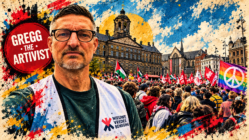
Last week I found myself in Barcelona for a Spanish and Dutch research group on activism and algorithms, where we were asked to help shape recommendations for a report based on conversations we had shared over the past months as activists, NGOs and grassroots organisations.
In its final hours, as we moved toward conclusions, I felt myself reflecting on our work in a different direction.
Not because the work was not valuable. It was. My colleagues brought so much care, experience and intelligence into the room that I felt privileged to be among them. But I also found myself sitting with an uneasy thought process that I could not fully resolve at the time.
I want to be clear that this is not a critique of one organisation, one group, or one meeting. It is a reflection sparked by that experience, and by questions I have been carrying for a long time about social media, activism, attention and impact.
I had already found myself playing devil’s advocate during the discussion, raising questions about whether we were confusing reach with resilience, or treating virality as if it were the same thing as impact. I also found myself wanting to slow the process down, not to block it, but because when things move fast, that is often the moment to ask whether we are asking the right question.
Even then, I knew I had not found the full shape of what I was trying to say. By the time we left to head back to the Netherlands, the feeling had started to bug me.
I wondered: as activists, what injustice are we really trying to resolve?
I realise this may sound like a question for activists, campaigners and NGOs. In one sense, it is. But the more I’ve sat with it since, the more I realised it is also a question about all of us.
Because the platforms activists are struggling to use are the same platforms shaping how many of us understand the world, relate to each other, process crisis, form opinions, respond to injustice, and measure what matters.
The Algorithmic Challenge
In the interest of context for readers outside the sector: social media is of course, where everyone seems to be.
So for activists, campaigners, NGOs and grassroots organisations, it makes sense that this is where we go to communicate our messages, share urgent information, build support and reach people beyond our existing circles.
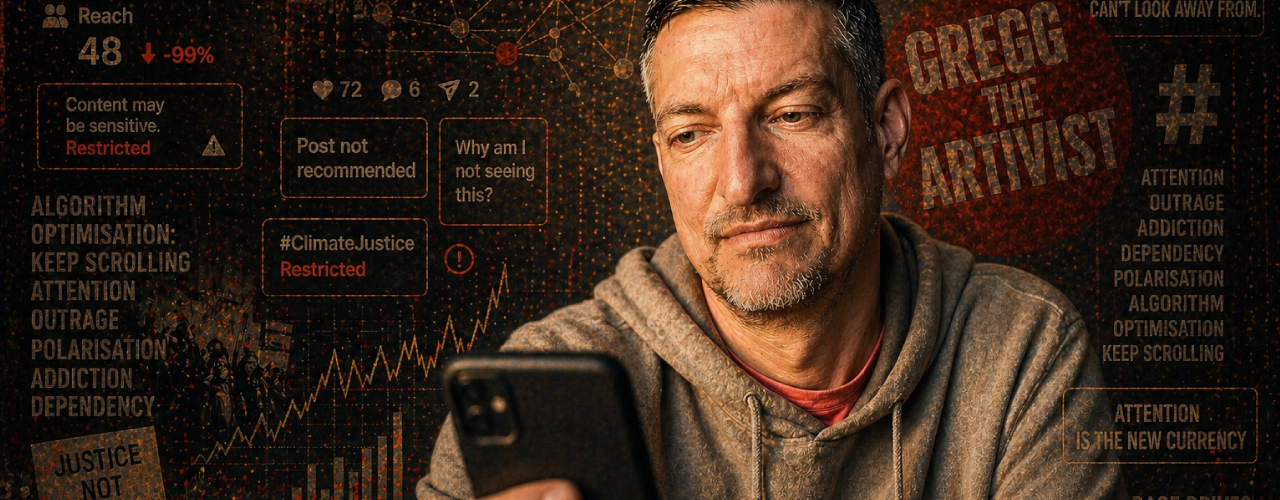
But increasingly, many of us are facing a different reality. Posts are moderated, deprioritised, restricted or removed. Certain words appear to trigger reduced visibility. Content linked to human rights, climate justice, genocide, war, racism, migration or political violence can feel like it disappears before it has even had a chance to move. Followers who actively want to see the work do not always see it. Reach drops without explanation. In some cases, people spoke of posts that once received tens of thousands of views now reaching fewer than fifty.
But let’s also be honest here, this is not just happening to activists. The platform has a strategy. Whether you are fighting for justice or sharing the latest holiday pic, not all content helps the platform achieve its objectives.
And as someone who has relied heavily on social media for reach, I can confirm the result is exhausting.
Like many, over the last five years in particular, I’ve poured thousands of hours into content that may never reach the people it was created for. Campaigns are carefully planned, filmed, edited, captioned, translated and posted, only to vanish into silence. Over time, this creates more than frustration. I’m personally aware of how it has changed my behaviour.
We begin to self-censor.
We avoid certain words. We soften language. We use coded phrases. We alter images. We rewrite captions. We try to guess what the platform might punish before we have even said what needs to be said.
And this is where the algorithmic challenge becomes more than a visibility problem. It becomes a shaping force. Because when activists start changing the truth to survive the platform, the platform is no longer just distributing the message. It is influencing the message itself.
But even as I recognise all of this, I keep coming back to a harder question.
Is this the injustice itself?
Or is it a symptom of something deeper?
The Wrong Injustice?
This brings me back to the question I kept circling around:
As activists, what injustice are we really trying to resolve?
Like many others, my first instinct was to feel that it is unjust when activists cannot get enough visibility on platforms. It was part of the reason why I agreed to be part of the Algorithms and Activists study. And of course, there is truth in that. As I had just mentioned, visibility matters when urgent messages are being hidden, suppressed or deprioritised.
But when I zoom out and look at how these platforms are shaping society as a whole, activist visibility starts to feel less like the core injustice and more like a symptom of something deeper.
Maybe the greater injustice is that society has become so dependent on platforms that manipulate attention, shape public discourse, reward outrage, exhaust users and make meaningful civic participation harder.

And I think this is where something shifted for me, because one way of seeing the problem is about activist access, while the other points to a much wider social harm.
Because if we frame the problem mainly as “activist content is not being seen,” then the solution becomes finding better ways for activists to perform inside the system. As an example, our group talked about sharing what works and social media “hacks.”
But if we frame the problem as “society is being shaped by platforms that profit from manipulation, distraction and dependency,” then it really changes the question.
We are no longer only asking how activists can get better access to the machine. We are asking why so much of our shared life has been handed over to systems that do not have human wellbeing at their centre.
And as I went through this thought process, I realised how much harder that question feels. Maybe it is the one we need to spend more time with.
Because once I saw the problem this way, another uncomfortable question appeared.
When we ask for better visibility on these platforms, are we challenging the system, or are we feeding it by asking for better access?
When Resistance Feeds the Machine
What happens when we adapt ourselves to the platform’s logic? This question popped into my head late on Saturday night.
From my experience, once we accept that social media is where people are, there’s this kind of immediate pressure to learn how the platform works. Create a regular posting schedule. Hook people faster. Use shorter sentences. Choose stronger images. Avoid certain words. Follow the trends. Make it emotional. Make it shareable. Make it impossible to scroll past. And so on.
Some of that is simply communication. If we want people to hear something, we have to think about how they receive it.
But this is where I feel conflicted.
There is a line where communication starts becoming compliance.
When activists chase virality, optimise for engagement, use rage bait, compress complexity into hooks, or compete for attention in the same ways brands and influencers do (Note: Meta’s own research showed you have 3 seconds to obtain attention), we may unintentionally strengthen the very logic we are trying to resist.
Worse, and hands up for this, we start measuring our work through the platform’s values.
Reach. Views. Shares. Watch time. Growth.
Of course these things can matter. If no one sees the message, the message cannot move. But after years of pouring myself into this work, it has been a hard lesson to accept: visibility is not the same as change. Attention is not the same as trust. Engagement is not the same as action.
I kept thinking about two sentences I had raised in the room:
We need to stop confusing reach with resilience. We need to stop treating virality as the same thing as impact.
I’ve reached a point where I strongly believe that if activism becomes too fluent in the language of the machine, we have to ask what happens to the parts of activism that do not fit inside it: complexity, slowness, relationship, care, repair, organising, grief, listening, and the long work of building trust.
Activism and Algorithms: The Unequal Choice
Of course, it is much easier to question our dependence on social media when we have other ways to communicate. My website, my app and my podcast are ways I’m trying to break this dependency, yet these take time that our messages often don’t have.
Some organisations, campaigns and funded projects have websites, mailing lists, media contacts, staff, communications budgets, partnerships and established audiences. They may still struggle with visibility, but they are not always starting from nothing.
For smaller grassroots groups, informal networks and individuals like myself, and certainly those I have spoken with, the situation can be very different.
Social media may be imperfect, extractive and harmful, but for many smaller groups it is still the only realistic place to find people, mobilise quickly, document harm, ask for support, share urgent updates or build pressure.
That is the real trap.
We can recognise that using these platforms may feed the system while also recognising that walking away from them is not equally possible for everyone.
So the question cannot simply be: should activists leave social media?
For many, that is just not a serious or even fair question.
A more realistic question is: how do we reduce our dependence on systems that many people still have no choice but to use? And how do we build alternatives without abandoning those who currently rely on the platforms most?
Who Are We Trying to Reach?
This question really stems from a previous life of mine as the owner of a communication and design agency. It was always the place where we started.
My line of thinking is this: if the deeper injustice is not only that activist content struggles to be seen, but that people are being shaped by platforms designed to keep them scrolling, then we also need to ask who we are actually trying to reach.
And I don’t mean “the public” as an abstract mass.
But people.
Tired people. Distracted people. Angry, numb, lonely, overwhelmed people. People trapped in doomscrolling loops. People looking for belonging. People who care deeply but do not know what to do with that care. People who have already seen too much, or felt too much, and had nowhere to put it.
This really changes the responsibility of activist communication.
Because if we are trying to reach people inside systems that already exhaust, manipulate and overstimulate them, then our task cannot simply be to grab attention. It has to be to consider the state people are in when our message reaches them.
My fear is this: are we adding clarity, or more panic? Are we opening a door, or tightening the trap? Are we inviting people into relationship, action and meaning, or are we simply competing for one more moment of reaction inside an already overloaded feed?
I am not saying activism should become soft, vague or afraid to tell the truth. Some truths are urgent. Some truths are horrifying. Some truths should disturb us.
But there are clear differences between: disturbing people into awareness and overwhelming them into shutdown. Asking people to care and leaving them alone with the weight of what they now know. Reaching someone and helping them stay with what they have seen long enough to act.
So to me, this feels more like where meaningful impact can begin. Not with how many people saw the post, but with what became possible after they did.
Beyond Reach
So what would meaningful impact look like?
Honestly, this feels like the million dollar question.
Further study matters. We need better evidence, clearer language and a deeper understanding of how platforms affect activist visibility, public discourse and civic participation.
But I also think something practical.
Perhaps that is a shared knowledge platform, where activists, NGOs, grassroots groups, researchers and affected communities can collect what they are learning in real time: examples of suppression, useful tools, platform changes, ethical communication practices, legal updates and alternatives.
And perhaps it is also a collective campaign that speaks beyond activist circles.
Not only about activist visibility, but about the wider impact social media is having on society: attention, addiction, mental health, public discourse, civic participation, political manipulation and democratic life.
Maybe every activist post could carry a small reminder, link or shared message about platform harm. Something simple and recognisable, almost like the warning labels we now expect on alcohol or cigarettes. Not to shame people for using social media, but to make the harm visible and offer tools, support and help for those struggling with digital addiction or platform dependency.
Because if we are serious about moving beyond reach, then our work cannot only be about getting better at using the system.
It also has to be about changing the conditions that made us so dependent on it.
The Question That Stayed With Me
I keep coming back to the beautiful room we sat in around the large table in Barcelona.
Something important happened there. There was an incredibly valuable exchange between Spanish and Dutch participants: real experiences, hard questions, frustrations, strategies and concerns. Knowledge, care and urgency were all present.
But maybe there was also a question that needed more time than we had.
How do we stop building movements around systems that were designed to keep people unwell, distracted and alone?
But I know I do not want activism to become better at performing inside systems that are harming us.
I want activism to help us see the harm more clearly. To name it. To resist it. To build other ways of finding each other. To create spaces where attention becomes relationship, where visibility becomes trust, and where impact means more than reach.
We all know the system feeds on our attention, so perhaps one of the most activist things we can do is stop treating attention as something to capture.
I think we need to start treating it as something to care for.
Hey friends,
If this reflection resonates, especially the idea of a shared knowledge platform or collective campaign around platform harm, I would be interested in hearing from others who want to explore it further.
— Gregg
FAQ's - Activism and Algorithms
What does activism and algorithms mean?
Activism and algorithms refers to the way social media platforms, recommendation systems, moderation tools and engagement driven feeds shape whether activist content is seen, hidden, amplified or ignored. It also raises deeper questions about how platform systems influence public attention, civic participation and social change.
Why is social media visibility a problem for activists?
Many activists, NGOs and grassroots groups rely on social media to share urgent messages, organise support and reach people beyond their existing networks. When posts are deprioritised, restricted, removed or shown to fewer followers without clear explanation, important information can disappear before it reaches the people it was created for.
Is the algorithm the main problem for activism?
The algorithm is part of the problem, but it is not the whole problem. Activists are also navigating profit driven platforms, social media addiction, opaque moderation, political pressure, declining trust, exhausted audiences and communication systems designed to reward attention rather than care, depth or meaningful action.
What is the difference between reach and impact?
Reach measures how many people may have seen a message. Impact asks what changed because of it. A post can reach thousands of people and still create little trust, action or resilience. A smaller conversation can sometimes lead to deeper understanding, stronger relationships and more meaningful change.
What could activists do beyond chasing reach?
Activists could build shared knowledge platforms, strengthen digital literacy, create community owned spaces, develop platform exit strategies, support ethical communication, campaign for platform accountability and measure success through trust, action, resilience and relationship rather than only views, likes or shares.
A note on process and AI assistance: This reflection is rooted in my own experience, questions and ongoing work around activism, social media and public communication. I used AI as a thinking partner while developing the article, mainly to help organise the structure and identify repetition. As well as technical 'behind-the-scenes' stuff like SEO and summaries for FAQ’s. The ideas, perspective, lived experience, words and final editorial choices remain my own.

I enjoyed your reflections what can we communicate about change when we are in a system not allowing communication. The conundrum is that we use the system – you used social media/AI to write an article critiquing it. We are in the system – we care – we dialogue – but we are kept in a bubble made by us and the system. How to change the narrative collectively and then do it – what could you imagine beyond resistance?
Thanks for taking the time to read and comment. Yes, great question.
I think you may have actually named this unease I’m feeling better than I did.
I agree with the conundrum. And maybe that’s why I feel so conflicted.
I’m definitely not outside the system. I’m using social media to share an article questioning social media. So I really hope the article doesn’t come across as me asking for some kind of purity, because I don’t think that’s realistic or helpful.
Your question pushes the conversation into a better place though. Not just what are we resisting, but what are we imagining and building?
Maybe the question is then: how do we care for attention, relationships and collective imagination inside a system designed to extract them?
I do think we need to be more honest about the bargain we’re making.
I definitely don’t have the full answer. But I think this is exactly the conversation I’d like us to keep having, and more importantly, testing together.
[…] challenges with the visibility of my own artivism and have explored these issues through my work on Activism and Algorithms. These experiences don't automatically establish censorship, but they provide important […]