






Radical Acceptance continues after this notice…
Dear friends,
Watching these READ articles grow in 2025 from a handful of people when I started, to over 1,000 readers weekly has been amazing. Thank you for being here.
One tiny confession: the comments section has been… a bit of a ghost town. 👻
So in 2026, I’d love to make this more of a real conversation. And if you’ve ever felt unsure how to respond to my posts, here’s your permission slip: you don’t need the perfect comment.
- “This resonated because…”
- “I’m still thinking about…”
- “I disagree, but…” (keep it kind 😅)
- Or even just a simple “I’m here.”
And if you want updates on new READ articles, WATCH videos, LISTEN podcasts, and upcoming online/offline EVENTS, you can join the email list.
— Gregg
Radical Acceptance
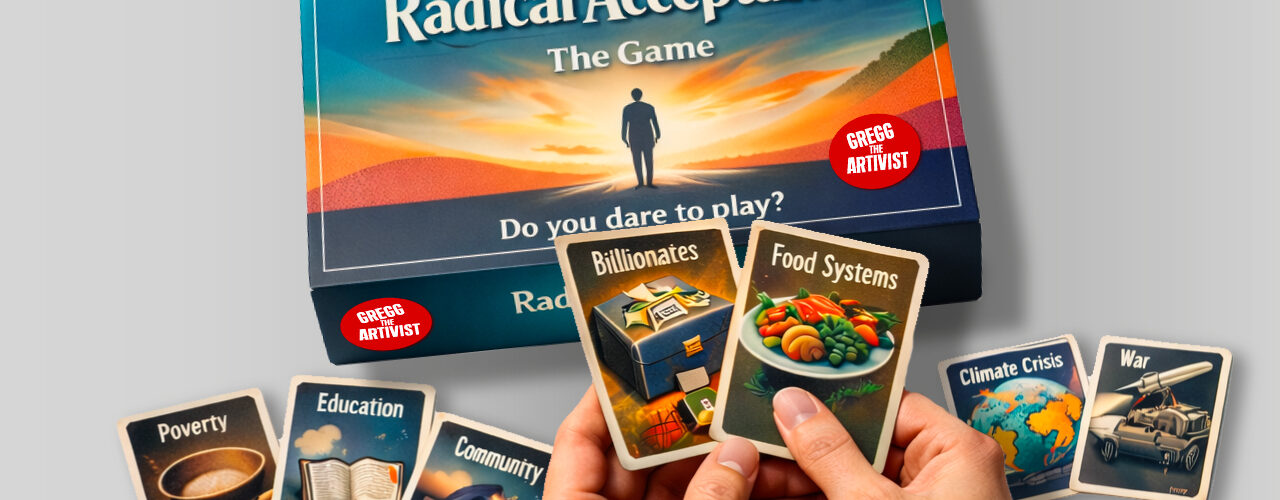
Do You Dare To Play?
I was not surprised that it was almost 5am when my head finally hit the pillow on Saturday morning in Brussels.
Midnight had already passed when the kind waitress at the local Italian restaurant gently ushered us out. The four of us flowed onto the street, my partner, our two expat friends we were staying with, and me. And the conversation did not skip a beat for even a second. It never does with them. Close friends, and that shared thing of being foreigners in a country abroad, and not pretending we have got it all worked out.
We talked about recent travels, tiny personal revelations, old regrets that still have a pulse, and the big floating question that seems to hover over so many dinners lately.
Where do we belong?
Not in the sentimental, passport kind of way, although that does come up practically. More like, where does your nervous system land. Where does your body unclench. Where does life feel like it fits. And of course we all have very unique responses to this.
And we always acknowledge when it sounds like we are complaining. "What first world issues we have!" someone will state the moment it checks. And still, they are heavy in their own way. Because even privileged uncertainty can still be uncertainty. And uncertainty has a way of digging its nails into the soft parts of a person.
At some point back at our friend's home, the conversation drifted into the existential, as it always does when the wine has done its work. And kinda suddenly I have to say. One minute it was topping up a glass and next we were deep in it.
Are we just messed up living in a messed up world?
Are we happy?
Or are we performing happiness because it is the only acceptable emotion in a culture that sells positivity like it is oxygen. Like everything else, hijacked by capitalism.
I kept thinking about how the word happiness gets used like a measure of success. Like proof of doing life correctly. Like something you can obtain if you just do the right combination of career choices, lifestyle upgrades, relationships, gym sessions, holidays, and mindset shifts.
But in that moment, sitting with my friends, I realised we were not actually talking about happiness.
We were talking about safety.
Because happiness, for a lot of us, becomes a synonym for stable… comfortable, settled and even certain.
And that is where the problem starts.
Happiness and Joy Are Not Twins
We needed to set the language at one point, just to make sure we were talking about the same thing.
Happiness often has a logic to it. It tends to show up when the conditions are right. Things are going well. You got what you wanted, the environment feels safe enough and the future looks predictable enough.
Happiness can be beautiful, soft and satisfying. A kind of exhale.
But joy is something else.
Joy can arrive when life is not tidy. It can appear in the middle of grief, during stress, even inside chaos, like a small bright flare you did not schedule. Because joy is more bodily. More surprising and less negotiated.
A laugh that escapes you, a sudden lift in your chest, being moved by beauty for no reason or a moment of connection that makes the world feel briefly humane again.
As I listened to the others deep in discussion about the difference of happiness and joy, it occurred to me, I chase happiness when I am scared... and joy often shows up when I stop chasing.

I also noticed something else.
The more uncertain the world feels, the more we start chasing happiness as if it will protect us. And the more we chase it, the more fragile we feel. It is brutal cycle.
Listen to my podcast: Rewrite Reality: Living with Uncertainty
I do not think anyone can argue with this right now. The world is not cooperating. I catch myself saying this a lot at the moment: "It's like the very foundation of certainty in the world we know, and the future we planned for, is being ripped out from beneath us. And it is hard to know what we do with that!"
The Real Enemy Is Resistance
Then there was this part that kept looping in my mind during the night.
Uncertainty does not just bring worry. It stirs insecurities. It pokes old wounds. It triggers the ancient parts of us that want guarantees before we relax. And when those parts get activated, we start resisting everything.
We resist the present because it is not calm enough. We resist our feelings because they are inconvenient and we resist reality because it does not match the story of how life should be.
We replay the past, trying to edit it. We overthink the future, trying to control it. We obsess over meaning, trying to justify discomfort and we hunt certainty like it is a rescue boat.
And we call all of that thinking. But I'm thinking that actually half of it is just resistance dressed up.
When I woke up on Saturday after a few hours sleep, I jumped to my phone to make notes for this article. Thumbs flying, half asleep, trying to pin down a thought before it escaped me. And reading back just now, this idea really stuck out... I wrote: 'Resistance is the extra thing (I think I meant layer), that turns pain into suffering'. Let me explain.
The world is uncertain. That is pain.
My mind insists it should not be uncertain. That is suffering.
I do not like this moment. That is pain.
My mind argues that this moment must change before I can be okay. That is suffering.
And this is where radical acceptance starts to feel less like a self help buzzword, and more like a survival skill.

Read my article: Even When Things Get Worse, I Will Keep Choosing What Builds Life
What Radical Acceptance Actually Means
So I started thinking about radical acceptance. I had to read up a little, and this is my takeaway.
Radical acceptance is the practice of fully acknowledging reality exactly as it is in this moment, without fighting it, denying it, or adding extra suffering through mental resistance.
Sounds simple, right. Well like most of these things, of course it is not easy.
It means catching your inner dialogue in real time, and reminding yourself: This is what is happening. I do not like it. I may work to change what I can. And I stop arguing with what is already true.
I think what I'm understanding is this: radical acceptance is not approval, not giving up, not pretending you are fine.
What it is, is the moment you stop wasting energy on a war you cannot win, so you can put that energy into a response that actually helps.
It is a mental and emotional shift from resistance to recognition. It makes space for facts, feelings, and consequences as they are, so you can choose your next action from a clearer place.
So while sitting there around the table in Brussels, listening to us all circle the same fears across different parts of our lives, some of us sounded like we were already practising radical acceptance without even calling it that, which was honestly inspiring to hear.
I am thinking this: the more uncertain the world becomes, the more radical acceptance stops being optional. It becomes foundational.
Maybe that is why it impacts different right now. Because if the world feels like it is pulling up the floorboards, we need something internal that does not move every time we read another shocking headline.
And this makes me feel weirdly good. When the foundations feel like they are being ripped out from under us, there is still something solid to land back on. Because honestly, if my nervous system is constantly waiting for certainty before it lets me live, I will end up postponing my entire life.
So Here Is The Game: Do You Dare To Play?
This is where my brain went, somewhere between midnight and morning.
What if the only thing we know for sure is this moment right now. I mean this as a practical truth, not a philosophical one.
We know our brains rewrite the past. They romanticise it, dramatise it, and basically edit it. We do not remember our earliest years. We rely on our parents, grandparents, and older siblings to tell us what we were like. And even our most vivid memories are not recordings. They are reconstructions.
And as for the future, well, it is a blank page we keep trying to control with prediction, planning, and anxiety.
So what would it mean if we accept this, radically.
- Everything before this moment shaped us.
- Everything after this moment is unknown.
- And this moment is the only place we actually get to choose.
The game is simple, and also terrifying.
- Live from what is here.
- Not from what should have been.
- Not from what might happen.
- From what is here.
And then ask.
If this is the only moment I can truly touch, what matters now.
- What is the next honest action.
- What is the next kind action.
- What is the next brave action.
Not the grand life plan, the ten year strategy or the perfect identity. Just the next step that aligns with reality.
Because radical acceptance does not shrink your life. It unclogs it. It returns your attention to the only place where your life is actually happening.
Back In Brussels
As we sat around our friends dining table, the conversation kept rolling with that kind of late night honesty you only get when nobody is performing anymore, and I realised something simple.
We are not broken because we feel unsettled in an unsettled world. We are not failing because we cannot manufacture certainty. Our nervous system is not a machine, and life is not a contract that promises clarity in exchange for good behaviour.
So obviously the real invitation is not to feel happy all the time. But I feel it is more to stop postponing our lives until the world becomes easier to accept. Because it might not.
So the dare to play is smaller than we think, and likely harder than we admit.
Can we stop arguing with what is already true. Can we meet this moment without demanding it be different before we allow ourselves to live inside it. Can we choose one honest next step, from the reality we actually have.
Radical acceptance is not surrender.
It is the bravest game I know.
Show up to the moment, and play it honestly.
Further 'off site' Reading
- Finding Peace with Radical Acceptance UR Medicine Behavioral Health Partners - A practical overview of radical acceptance as a way to reduce the struggle with what you cannot control and respond with more self compassion.
- Radical Acceptance Skill DBT Tools - A clear DBT focused explanation of radical acceptance with simple guidance on what it is and how to practice it.
FAQs
What is radical acceptance?
Radical acceptance is the practice of acknowledging reality as it is in the present moment, without adding extra suffering through mental resistance. It does not mean approval. It means clarity, so you can choose your next action.
How does radical acceptance help in uncertain times?
In uncertain times, the nervous system often waits for certainty before it relaxes. Radical acceptance helps you stop arguing with what is already true, so you can respond with steadier choices, better boundaries, and more presence.
Is radical acceptance the same as giving up
No. Radical acceptance is not surrender. It is recognising what is real, then focusing your energy on what you can influence. It supports action because it reduces wasted energy.
What is the difference between happiness and joy?
Happiness often depends on conditions such as stability and predictability. Joy can show up even when life is messy. Joy is more about presence and connection than getting life to cooperate.
What is a simple radical acceptance practice I can use today?
Name the facts, name the feeling, notice the resistance, repeat an acceptance sentence, then choose one next action you can actually do. Small steps are what reality is made of.
Want to reprint or collaborate on written work about Climate Storytelling?
I welcome inquiries for republishing, co-writing, guest contributions, and creative collaborations rooted in justice, systems, and story. Reach out if my work resonates. Contact Me

[…] READ 'Radical Acceptance – Do You Dare Play?' here. […]